The Next Evolution of Imaging: From Connectivity to Intelligence
Introduction
For nearly two decades, Enterprise Imaging (EI) has helped healthcare organizations break down silos, connect systems, reduce operational costs, and improve access to imaging information across the enterprise. By enabling interoperability and creating more connected imaging environments, enterprise imaging has played a critical role in modernizing healthcare imaging operations.
But even with all the advantages enterprise imaging has provided, healthcare continues to evolve.
Today’s healthcare organizations face challenges that extend far beyond connectivity. Imaging volumes continue to rise, staffing shortages persist, and AI initiatives are accelerating. Additionally, care delivery is becoming increasingly distributed, and healthcare leaders are under growing pressure to improve operational efficiency while reducing costs, all while delivering the highest-quality patient care.
These challenges are here to stay, so to support better care delivery, we must look to technology to solve some of our most challenging problems.
Enterprise Imaging Changed Healthcare
EI solutions enable and optimize workflows and patient care by capturing, analyzing, AI-enabling, routing, prioritizing, fetching, viewing, integrating, managing, securing, reporting, exchanging, archiving, and governing clinical images, photos, and multimedia content from multi-ologies to enhance the electronic medical record (EMR). They also provide high-performing diagnostic tools to physicians to view, diagnose, offer insight, share opinions, and make informed patient-care decisions. As a patient centric workflow solution, they help dismantle silos of data and become the source of truth for any image acquired in a healthcare organization. Enterprise Imaging solved a fundamental problem that faced healthcare organizations for decades: disconnected systems and care teams (Rufer, Douglas A. “The Value of an Enterprise Imaging Strategy.” Mach7 Technologies, 5 Sept. 2019.).
By breaking down and consolidating siloed archives into a single enterprise platform, organizations were better able to connect radiology, cardiology, and other visible light archives within their EHRs. By connecting the patient’s imaging record into their health record, data access and care collaboration significantly improved. Not only did access improve, but imaging workflows improved. The overall result was a more efficient enterprise when it came to imaging data.
These investments delivered significant value by helping organizations:
- Eliminate imaging silos
- Improve interoperability
- Expand access to clinical information
- Support enterprise-wide collaboration
- Create a foundation for future innovation
Enterprise Imaging remains an essential part of modern healthcare infrastructure. But in today’s fast-paced healthcare environment, connectivity alone is no longer enough.
Healthcare’s Challenges Have Changed
Today’s healthcare leaders are asking different questions. The challenge is no longer connecting their imaging systems into a consolidated backend. It’s now determining how to intelligently orchestrate operations across those systems. Without workflow improvements that can flag important notes or automate routine and mundane tasks, only so much efficiency can be gained. Today’s organizations need to make faster, more informed decisions and collaborate with the right team members to ensure top-notch patient care and improved outcomes are achieved.
Better workflow orchestration helps healthcare organizations reduce operational inefficiencies, eliminate delays, and improve coordination across the care continuum. The result is lower costs, more efficient care delivery, improved patient outcomes, and a better experience for both patients and providers.
So, what do today’s leading healthcare organizations focus on? Things like:
- Improving operational efficiency
- Managing growing imaging volumes
- Addressing staffing shortages
- Supporting and growing AI initiatives
- Standardizing workflows and simplifying complexity
- Improving patient experiences across the enterprise
- Reducing overall complexity to reduce workflow burdens and improve operations
These challenges require more than connected systems. They require intelligent operations.
Connectivity Alone Does Not Create Operational Transformation
Many healthcare organizations have already invested heavily in enterprise imaging initiatives and their investments have certainly paid off. Consolidated archives, improved image access within the EHR, better care team collaboration, and lowered operational costs are a few of the benefits achieved.
But even with these improvements, more can be done to elevate enterprise imaging to the next level and address today’s new demands. Connected data, consolidated archives, moving to the cloud, and improved system integrations are only part of the battle.
Operational challenges still remain and organizations continue to struggle with:
- Time consuming manual workflows
- Complex data movement requirements
- Inconsistent operational workflows
- AI deployment challenges
- Cross-platform workflow inefficiencies
Connecting systems and making information accessible is only part of the challenge. As healthcare organizations continue to consolidate data across imaging, clinical, and operational systems, a new problem emerges: information overload.
Clinicians are already managing increasing patient volumes, growing documentation requirements, and an expanding set of diagnostic tools. Simply providing access to more information does not necessarily improve decision-making. In fact, without the ability to surface relevant insights quickly and contextually, the sheer volume of available information can become overwhelming.
The critical question becomes: How can clinicians identify the most relevant information within seconds? How do they quickly recognize significant findings, uncover information that may have been overlooked, and focus on the data that will most directly impact patient care?
This is where intelligence becomes as important as connectivity. Healthcare organizations need systems that can help prioritize information, support clinical decision-making, and deliver the right information to the right person at the right time. Without that capability, user adoption declines, workflows become fragmented, and organizations risk failing to realize the full value of their enterprise imaging and digital transformation investments.
The future of imaging is not simply about connecting information. It is about transforming information into actionable intelligence that helps clinicians make better decisions, improves care pathways, and ultimately delivers better patient outcomes.
Connecting data is important, but creating intelligent operations is the evolutionary next step in enterprise imaging.
The Emergence of Imaging Intelligence
The next evolution of imaging is not to replace the time and investments brought about with enterprise imaging, it’s to build upon it. The systems and connectivity that form enterprise imaging become the foundation, while intelligence is the next step organizations should take to evolve.
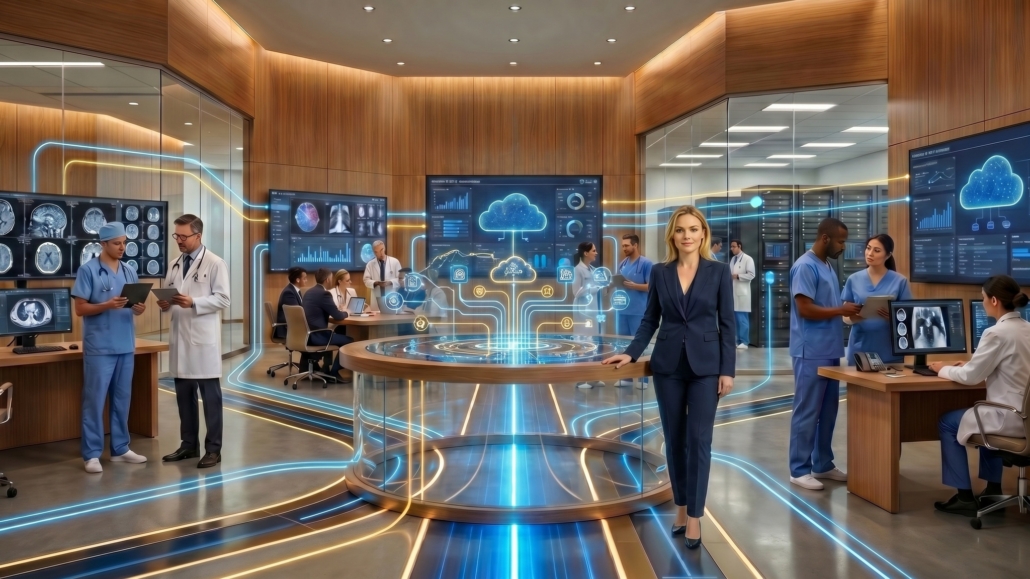
Imaging Intelligence represents a connected operational ecosystem that transforms all imaging data, workflows, infrastructure, and clinical systems into actionable intelligence that improves efficiency, collaboration, scalability, and patient outcomes. Without a solid enterprise imaging backbone, imaging intelligence cannot exist.
Think of it this way. Enterprise Imaging is the foundation of connected care, but Imaging Intelligence delivers operational transformation.
Rather than focusing solely on connectivity, Imaging Intelligence focuses on helping healthcare organizations orchestrate, automate, and optimize imaging operations across the enterprise.
The Role of Workflow Orchestration
Enterprise Imaging provides the consolidation, connectivity, and collaboration backend needed for advanced healthcare workflows. But workflow orchestration is the bridge between a connected infrastructure and intelligent operations. Without it, your connected environment will not perform at the level you expect.
Workflow orchestration has been widely available for years and many organizations possess vendor solutions that offer improved workflow operations. Yet most capabilities available today manage data movement from point A to point B. What’s missing is coordinating workflow operations across dozens of systems, locations, workflows, and stakeholders.
Workflow orchestration for imaging is the intelligent coordination of imaging data, systems, workflows, and operational processes to ensure the right information reaches the right destination at the right time, while minimizing manual intervention and operational complexity.
Older orchestration solutions focus on data movement, message transformation, routing, and system connections. Today’s orchestration solutions, such as Axiom Flow™ by InsiteOne, offers the ability to provide operational coordination, workflow standardization, intelligent routing decisions, exception handling, AI enablement, and enterprise scalability. That may not seem like much, but it’s a far leap over traditional workflow orchestration solutions.
As healthcare environments become increasingly complex, organizations need the ability to intelligently move information, automate processes, standardize workflows, and improve operational visibility across disparate systems.
Workflow orchestration enables healthcare organizations to:
- Standardize to reduce operational complexity and reduce workflow variations across systems and sites.
- Automate manual and repetitive tasks to improve workflow consistency
- Orchestrate workflows across PACS, VNA AI, and EHRs to improve outcomes
- Enable elevated enterprise imaging workflows, AI initiatives, cloud transformation, which leads to operational modernization.
The organizations that can effectively orchestrate imaging operations will be best positioned to adapt to the next generation of healthcare delivery. They will be able to reduce complexity across their enterprise, standardize complex workflow across multiple locations, improve efficiency, and reduce the burden of custom integrations and manual processes.
The Future of Imaging Isn’t Just Connected…It’s Intelligent.
For years, healthcare organizations invested in connecting imaging systems across the enterprise. Those investments helped eliminate silos, improve information access, and create the foundation for more collaborative care.
That work remains critically important, but connectivity is no longer the destination.
Healthcare organizations are entering an era where imaging must do more than store, move, and display information. Imaging must help organizations operate more efficiently, support increasingly complex workflows, enable AI initiatives, improve clinical collaboration, and deliver greater value across the enterprise.
The future of imaging will be defined not by how many systems are connected, but by how effectively those systems work together to drive operational performance and clinical outcomes.
Organizations that embrace Imaging Intelligence will be better positioned to reduce complexity, improve scalability, accelerate innovation, and create more connected experiences for clinicians and patients alike. They will move beyond managing imaging infrastructure and begin leveraging imaging as a strategic enterprise asset capable of driving transformation across healthcare operations.
Enterprise Imaging laid the foundation. Workflow orchestration provides the operational framework, and Imaging Intelligence represents the next evolution.
That’s why we like to say that the future of imaging isn’t just connected…It’s intelligent. And the organizations that recognize that shift will be the ones best prepared for the challenges and opportunities of tomorrow.
What’s Next?
Be sure to stay tuned and connect with InsiteOne to learn how Imaging Intelligence can transform your organization and with AHRA right around the corner in Orlando, FL, we’ll be there to discuss your current workflow challenges.
Although InsiteOne will not have a booth at this year’s conference, please reach out to us if you want to meet to learn more about how imaging intelligence can help your organization become more connected, intelligent, and operationally aware.
For more information on how InsiteOne can provide a tailored solution to meet your organization’s Imaging IT needs, including workflow orchestration and imaging intelligence solutions, contact us today at 866.467.4831 or visit us here.