From Infrastructure to Intelligence: The Next Evolution of Enterprise Imaging
Introduction
Medical Imaging has come a long way over the past two-three decades and we’re once again starting to see a shift in strategy. In the past, many healthcare organizations have invested heavily in modernizing their infrastructure – improved networks, better security, moving infrastructure from on-premises hardware to the cloud, implementing vendor-neutral archives to consolidate storage and reduce vendor lock-in, and finally, replacing legacy PACS systems.
Over the past several years, healthcare organizations have focused heavily on infrastructure modernization, moving to the cloud, consolidating storage, improving cybersecurity, and replacing aging PACS environments. But the conversation is changing.
Today, the challenge is no longer simply modernizing infrastructure. It’s making increasingly complex imaging environments work together intelligently.
In our daily calls, that’s where we are starting to see the more conversations occur. Investments in systems and infrastructure are great, but workflow orchestration has taken hold. Meaning how do you connect systems, reduce manual steps, and improve how imaging moves across the organization.
Sure, workflow orchestration conversations have been going on for some time, but when you really get into those conversations, something else is becoming increasingly clear:
Even orchestration isn’t the final step.
The Limitation of Solving Problems in Pieces
Very few healthcare organizations have realized what the next step is, meaning most imaging environments are still built around and operating as a collection of systems:
- PACS for image interpretation and distribution
- Vendor Neutral Archives (VNA) for long-term storage and future growth
- Viewers for access and collaboration
- Routing engines to handle manual workflow steps
- AI tools layered on top to improve workflow or manage first pass image analysis
Each system was designed to solve a specific problem. But together, they often create operational fragmentation, disconnected workflows, and increasing complexity across the imaging ecosystem.
The challenge isn’t any one system. The challenge is getting them to operate in unison – much like an orchestra. Every system has a role.
But the real performance only happens when they work together as a coordinated whole.
The Shift Toward Enterprise Imaging Platforms
We’re now seeing a clear shift in the market: From managing individual systems to operating them within a unified enterprise imaging platform.
But you may say, Enterprise Imaging has been around for quite some time. True, it has, but in a different form. Recall the authors of the HIMSS-SIIM Collaborative White Papers when they defined enterprise imaging as: “a set of strategies, initiatives and workflows implemented across a healthcare enterprise to consistently and optimally capture, index, manage, store, distribute, view, exchange, and analyze all clinical imaging and multimedia content to enhance the electronic health record (Roth, C.J., Lannum, L.M. & Persons, K.R. J Digit Imaging (2016) 29: 530. https://pubmed.ncbi.nlm.nih.gov/27245774/).”
So yes, enterprise imaging has been around for some time – but it’s now evolving into so much more. It’s no longer about just consolidation. It’s about alignment.
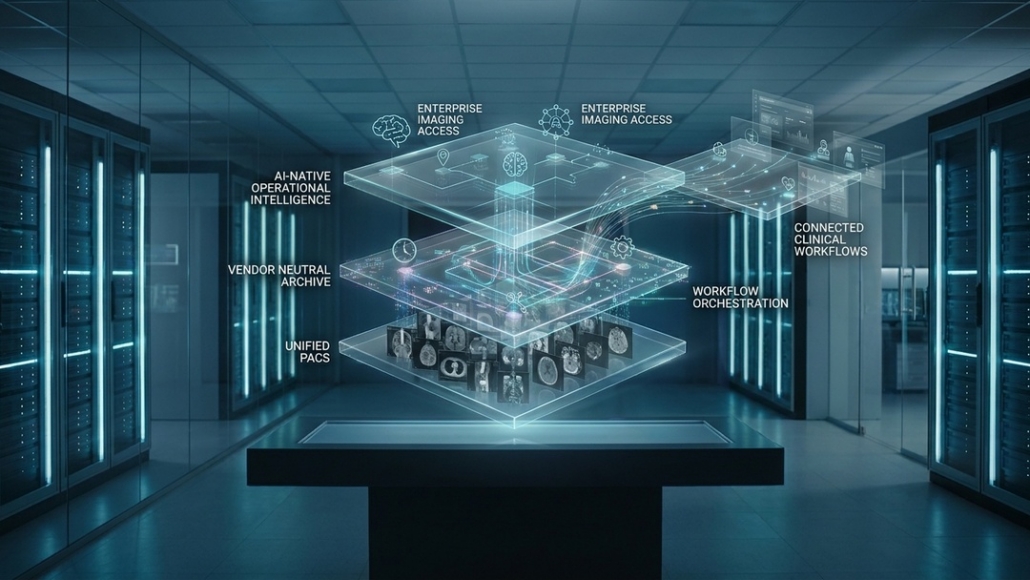
Today’s platform approach is different, as it brings together:
- Organizational Imaging Strategy
- Comprehensive Infrastructure for future scalability
- Workflow orchestration and system interoperability
- Data access and governance
- Workflow and clinical Artificial Intelligence (AI) capabilities and insights
All into a single, cohesive environment. Not stitched together-but designed to work as one.
The Emergence of the Imaging Intelligence Platform
Traditional enterprise imaging platforms were designed to centralize access, standardize workflows, and improve interoperability across the organization. But healthcare organizations are now facing a different challenge: How do systems not only connect, but operate intelligently together?
This is where the Imaging Intelligence Platform begins to emerge.
An Imaging Intelligence Platform extends beyond storage, viewing, and workflow coordination by introducing:
- Intelligent workflow orchestration
- AI-native workflow optimization
- Operational insight and advanced automation
- Real-time data intelligence
- Dynamic workflow adaptability
But what about Enterprise imaging connected systems? Imaging Intelligence Platforms make them work together, intelligently.
Why AI Changes the Equation
Artificial intelligence (AI) has been a major focus in imaging over the past 3-5 years, but in many environments, it remains disconnected from the workflow it’s meant to enhance. The next phase in imaging and AI is different.
AI is no longer simply being layered onto workflows. It’s becoming embedded directly into the operational fabric of the imaging environment itself, helping prioritize workflows, surface insights, automate decisions, and improve how care teams interact with imaging data.
This shift from AI-enabled workflows to AI-native platforms is what will define the next generation of enterprise imaging.
From Connection to Intelligence
Workflow orchestration helped solve a critical problem: Connecting systems that weren’t designed to work together. But connection alone isn’t enough.
The next step is intelligence.
- Understanding where bottlenecks exist
- Automating decision points
- Surfacing the right data at the right time
- Enabling workflows to adapt dynamically
This is where enterprise imaging platforms begin to separate from traditional architectures.
What This Means for Healthcare Organizations
For imaging and IT leaders, this shift raises an important question: How do we move forward without starting over? Because the reality is, many organizations have invested heavily in their enterprise imaging strategies and solutions but may not be capitalizing on everything an enterprise imaging solution can be.
A rip and replace strategy for enterprise imaging is significantly costly and very few, if any organizations I know are in a position to go down that path. And honestly, they shouldn’t have to do that.
In fact, the shift occurring is capitalizing on these following strategies:
- Building a next generation enterprise imaging strategy on existing infrastructure
- Introducing advanced orchestration in the workflow process everywhere it’s needed
- Expanding traditional enterprise imaging strategies into Imaging Intelligence Platforms designed for intelligent orchestration, operational insight, and AI-native workflows
None of this is happening as a single decision. It’s a progression that is starting to change how the industry is thinking about advanced, unified patient care.
Where We’re Headed
At InsiteOne, our focus has always been on helping organizations move from complexity to clarity. When we introduced the first cloud-based image archive, we were focused on infrastructure. Our latest solution expands our journey into advanced workflow orchestration. And now? It’s evolving into something even bigger:
A comprehensive, unified approach to enterprise imaging, where systems, workflows, and insights, and intelligence are aligned from the start.
We’re not chasing the next trend. We’re building an environment that can scale, adapt, and support the future of imaging in healthcare. And the best part? You don’t have to change your infrastructure in place today to join us on this journey.
The Outcome That MattersFrom Infrastructure to Intelligence: The Next Evolution of Enterprise Imaging
This shift isn’t about platforms or architecture. It’s about what happens because of them.
- Faster access to imaging data from anywhere, at any time. No bottlenecks and no more silos.
- Highly evolved workflows that truly drive significant process improvements
- Enhanced care collaboration across departments
- More insight, allowing for more informed clinical decisions that directly impact patient care
Because better connected systems lead to better efficiency, and ultimately, better patient care.
Looking Ahead to SIIM
As we head to SIIM 2026 next week, the conversation is evolving beyond individual systems and point solutions. Healthcare organizations are beginning to rethink enterprise imaging as something more connected, intelligent, and operationally aware.
That next phase is already beginning to take shape.
If you’re attending SIIM and exploring what the future of enterprise imaging could look like in your environment, we’d welcome the opportunity to continue the conversation at booth #209.
For more information on how InsiteOne can provide a tailored solution to meet your organization’s Imaging IT needs, including workflow orchestration solutions, contact us today at 866.467.4831 or visit us here.