Building A Scalable Imaging Infrastructure
Watching Radiology evolve from film to digital has been an extraordinary experience. In fact, today, radiology is no longer just a diagnostic department. It’s a data engine.
For decades, Picture Archiving and Communication Systems (PACS) served as the backbone of imaging operations, managing acquisition, storage, and interpretation all within radiology. But today, the demands placed on imaging have fundamentally changed.
The reality is not: “Is our PACS working?”
It’s: “Is our imaging infrastructure built to scale and evolve for the future?”
Imaging Growth Is Outpacing Traditional Models
Healthcare systems are continually evolving and most are experiencing sustained growth in imaging volumes, driven by aging populations, expanded clinical use cases, and increasing reliance on imaging across many care pathways. At the same time, workforce growth has not kept pace with image volumes growth, and this has created operational strain across radiology and into the enterprise.
Recent analyses show imaging demand continuing to rise while staffing constraints persist, reinforcing the need for more efficient, scalable workflows and infrastructure models that reduce manual intervention and variability in care delivery.
At the same time, imaging is no longer confined to radiology. Cardiology, pathology, dermatology, ophthalmology, and other specialties generate a significant volume of image-based data, and oftentimes, each system is still managed in separate systems creating data silos that spell inefficiency and lack of interoperability.
The result? Data fragmentation, duplication, and inefficiency.
The Limits of a PACS-Centric Strategy
PACS were never designed to manage imaging at enterprise scale, since they focused on imaging workflows within radiology departments.
They were built to:
- Manage departmental workflows
- Handle radiology-specific use cases
- Localized infrastructure
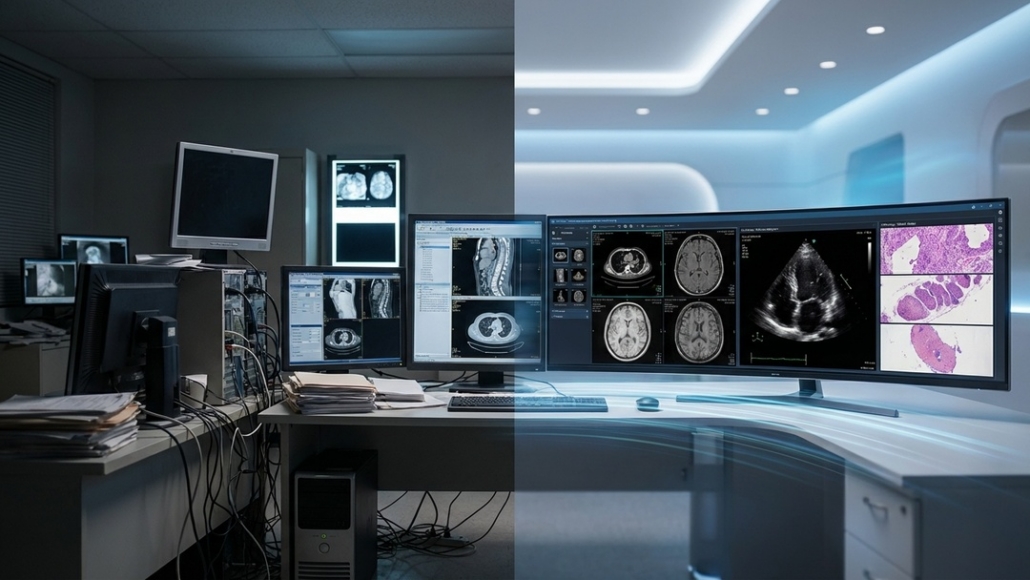
While modern PACS platforms have evolved, the underlying model remains largely unchanged. In many organizations, imaging environments still consist of multiple systems, siloed archives, and disconnected workflows, requiring clinicians and IT teams to bridge the gaps manually.
So what are the hidden costs of this ecosystem?
- Duplicate workflows across departments
- Inconsistent access to patient imaging and historical studies
- Complex integrations with EHRs and AI tools
- Ongoing data migration challenges due to loose adherence to industry standards
In a world where imaging is central to care delivery, these limitations become increasingly difficult to sustain.
From Systems to Platforms: The Rise of Enterprise Imaging
Have you wondered why conversations have once again moved to the enterprise? Since the pandemic is behind us and the cost of care continues to rise, there is a shift once again to move beyond technology in imaging and focus on it’s overall operating model.
Enterprise imaging platforms are emerging as the foundation for modern imaging infrastructure, enabling organizations to:
- Manage imaging as a longitudinal patient asset
- Consolidate storage across specialties
- Provide enterprise-wide access through the EHR
- Reduce system sprawl and integration complexity
The HIMSS–SIIM Enterprise Imaging Workgroup defines enterprise imaging as a strategy to “capture, manage, store, distribute, and analyze all clinical imaging and multimedia content across the healthcare enterprise.”
In practice, this means moving from department-centric systems to enterprise-wide platforms designed for scale, interoperability, and collaboration.
Cloud Enables Modern Imaging Infrastructure
How does our industry get to a modern infrastructure to support the demands of an enterprise imaging ecosystem? In essence, cloud architecture is the key and today is critical in the transformation.
Increasingly, we are seeing healthcare organizations ask for and adopt cloud-based models to:
- Scale imaging storage and compute power elastically
- Support distributed and remote reading workflows without disruption
- Improve resilience and disaster recovery capabilities in light of common cybersecurity concerns
- Reduce the burden of maintaining on-premises infrastructure due to the demand for skilled staffing
Industry trends have been showing a clear shift toward cloud-based imaging environments over the past few years, with growing adoption driven by the need for flexibility, security, and operational efficiency while keeping costs consistent.
For imaging specifically, cloud enables something critical: access without constraint across locations, specialties, and care settings. Having this flexibility provides organizations with the ability to quickly scale and adapt without having to continually invest in new infrastructure
Workflow Steals the Show
As imaging scales, the biggest challenge is no longer storage, it is enterprise workflows. Manual processes, static worklists, and disconnected systems cannot keep pace with rising exam volumes, distributed care teams, subspecialty reads, and increased expectations for turnaround time.
This is where modern imaging infrastructure is evolving most rapidly. Workflow orchestration, or coordinating how imaging work moves across systems, people, and locations, is becoming a defining capability by enabling organizations to:
- Reduce manual intervention
- Eliminate duplicate workflows
- Balance workloads across teams
- Improve consistency and predictability
In short, it allows imaging operations to scale without creating complexity, as well as provide the flexibility to adapt to future needs as workflow adapts over time.
Vendor Neutrality and Interoperability Matter
As imaging ecosystems expand, interoperability becomes critical. Standards such as DICOMweb and FHIR are enabling more flexible data exchange, allowing imaging data to move more freely between systems, applications, and care environments.
Vendor-neutral architectures further protect organizations from lock-in, ensuring that imaging data remains accessible and usable over time, regardless of changes in vendors, platforms, or technologies. This lowers long-term data migration costs while allowing organizations to cost-effectively change applications as their needs evolve.
This becomes even more important as AI adoption accelerates in healthcare.
AI as the Multiplier
Artificial intelligence (AI) is one of the most discussed topics in imaging today, but its success depends on the underlying infrastructure and the workflow adoptions that must occur to use this technology. Without careful planning and the right integrations, adopting AI may decrease your efficiency rather than increase it.
For AI to be successful in your organization, it requires:
- Access to large, well-organized datasets – not just initially, but training must continue over time to maintain accuracy rates on your population’s data
- Seamless integration into clinical workflows – make sure the AI is not increasing steps in your process or the efficiency gains will not come as expected
- Scalable compute resources
Enterprise imaging platforms, particularly those built on cloud architectures, provide the foundation needed to deploy and scale AI effectively, but without a proper foundation, AI risks becoming just another siloed tool that will see diminished use.
Designing Strategy Rather than Maintaining Systems
The evolution beyond PACS is not about replacing one system with another, it’s about shifting your organizations strategy from:
- Maintaining an existing infrastructure → designing scalable operations on today’s latest technology
- Managing images → managing workflows and data
- Supporting departments → enabling enterprise workflows that positively impact care teams and patient outcomes
Healthcare organizations that embrace this shift are better positioned to improve their overall operational efficiency while supporting their clinicians with better workflows. A further benefit is enabling the innovations that AI can bring to organizations while delivering more coordinated and patient-centered care.
Final Thoughts
Today’s modern imaging infrastructure is no longer just a concern for IT in today’s busy health systems. It becomes the foundation that makes your imaging and information infrastructure a strategic asset.
If your environment still feels reactive, you’re still patching outdated workflows, managing silos of disconnected data still exists, and you find you are continually adapting to infrastructure limitations, it might be time to reimagine your infrastructure strategy.
One thing is for certain: organizations will continue to be impacted by policy and operational challenges but having an adaptable infrastructure will better allow your organization to embrace these changes. The organizations that thrive in this new world will be the ones that have the best infrastructure, operational, and imaging strategy.
For more information on how InsiteOne can provide a tailored solution to meet your organization’s Imaging IT needs, contact us today at 866.467.4831 or visit us here.